
Finding reliable IPTV American channels has become an increasingly common search for viewers who want access to U.S. live television over an internet connection.
Instead of depending entirely on traditional cable or satellite packages, viewers can use internet-based television services and compatible IPTV players to organize live channels, electronic program guides, and other television content in one place.
But there is a catch.
Not every IPTV service offers the same American channel lineup, streaming quality, device compatibility, or reliability. Some services may advertise thousands of channels while offering limited information about where their content comes from.
This guide explains what to look for when searching for IPTV American channels, which U.S. networks are particularly popular, how channel categories differ, what devices can be used, and how to evaluate an IPTV provider responsibly.
Table of Contents
- What Are IPTV American Channels?
- How IPTV Delivers American Live TV
- Most Popular American TV Channels
- Popular U.S. Channels by Category
- American Broadcast Networks
- American News Channels
- American Sports Channels
- Entertainment and Movie Channels
- Kids and Family Channels
- Local American TV Channels
- What to Look for in an American IPTV Channel Lineup
- IPTV Streaming Quality and Reliability
- IPTV Device Compatibility
- IPTV American Channels M3U Playlists
- Internet Speed for American IPTV
- How to Choose an IPTV Provider
- IPTV vs Cable, Satellite, and Streaming Apps
- Frequently Asked Questions
- Conclusion
What Are IPTV American Channels?
IPTV American channels are television channels delivered over an internet connection using Internet Protocol technology.
The basic concept is straightforward. Instead of receiving television signals through traditional cable infrastructure, an antenna, or a satellite dish, IPTV delivers video data through an IP network.
Depending on the service and its licensing arrangements, an IPTV lineup may contain U.S. broadcast networks, cable channels, regional stations, sports networks, news channels, entertainment networks, and other programming.
The actual channel selection varies significantly between providers.
That is why checking the channel list before subscribing is important.
A service advertising “American IPTV” may have a large number of channels but still lack the particular network you want. Another provider may have fewer channels but better coverage of the categories you actually watch.
How IPTV Delivers American Live TV
When you watch an IPTV channel, video data is transmitted over an internet connection to a compatible application or device.
The IPTV player receives the stream and decodes it so that the content can appear on your television, computer, smartphone, or other supported device.
A typical setup can include:
Internet connection → IPTV service → IPTV player → TV or streaming device
The experience depends on several factors, including the quality of the source stream, server performance, network congestion, your internet connection, and the capabilities of your playback device.
For this reason, having a fast internet connection alone does not guarantee perfect IPTV performance.
Most Popular American TV Channels
The United States has an enormous television market, with broadcast networks and hundreds of cable and specialty channels.
Recent 2025 audience data show that major networks such as CBS, NBC, ABC, FOX, Fox News, and ESPN were among the most-watched U.S. networks, while networks such as TNT, CNN, HGTV, TBS, USA Network, TLC, and others also attracted substantial audiences.
Rather than treating this as a permanent ranking, it is more useful to organize popular American channels according to what viewers generally use them for.
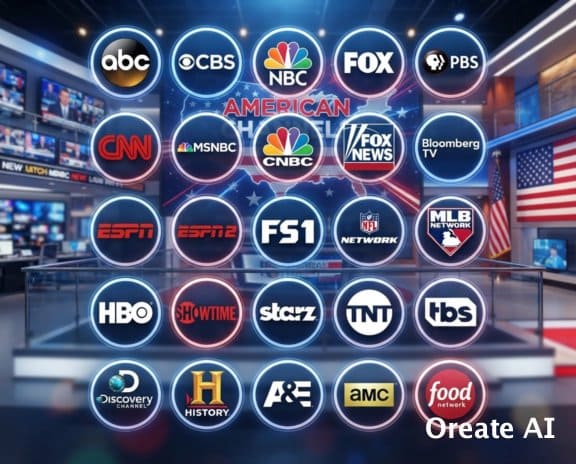
Popular iptv American Channels at a Glance
| Category | Popular U.S. Channels |
|---|---|
| Broadcast TV | ABC, CBS, NBC, FOX |
| News | Fox News, CNN, MSNBC/MS NOW |
| Sports | ESPN, ESPN2, FS1, TNT |
| Entertainment | TBS, USA Network, Bravo, FX |
| Reality & Lifestyle | TLC, HGTV, Food Network |
| Movies & Series | AMC, FX, Paramount Network |
| Kids & Family | Nickelodeon, Disney Channel, Freeform |
| History & Documentary | History Channel, Discovery Channel, National Geographic |
| Spanish-Language | Univision, Telemundo, UniMás |
| Local TV | ABC, CBS, NBC, and FOX affiliates |
This list is intended as a practical reference rather than a definitive ranking. Channel popularity changes according to the program, season, sports calendar, demographic, and measurement period.
Popular U.S. Channels by Category
1. Broadcast Television Networks
The major American broadcast networks remain central to the U.S. television landscape.
ABC
ABC offers a broad mixture of news, entertainment, scripted programming, reality television, and live events.
CBS
CBS is one of the country’s major broadcast networks and has historically attracted large audiences across news, entertainment, and sports programming.
NBC
NBC is another major U.S. broadcast network, known for entertainment programming, news, and major live sports coverage.
FOX
FOX combines entertainment programming with major sports broadcasts and news through its broader television ecosystem.
Recent 2025 network data placed CBS, NBC, ABC, and FOX among the leading U.S. broadcast networks by total audience.
2. Popular iptv American News Channels
News remains one of the most frequently requested categories when viewers search for American IPTV channels.
Commonly requested networks include:
- Fox News
- CNN
- MSNBC / MS NOW
- CNBC
- Bloomberg Television
- NewsNation
Audience levels vary considerably depending on the period and measurement method. For example, Fox News reported that it had its highest-rated non-election year in 2025, citing Nielsen data.
For viewers interested in news, the important question is not simply whether a provider lists a network.
Check whether the channel is actually available as a stable live feed, whether an EPG is included, and whether the service provides the appropriate regional version.
3. Popular iptv American Sports Channels
Sports is another major reason viewers search for IPTV American channels.
Popular networks include:
- ESPN
- ESPN2
- ESPNU
- FS1
- FS2
- TNT
- TBS
- NFL Network
- NBA TV
- MLB Network
- Golf Channel
ESPN was among the most-watched U.S. networks in 2025, while TNT and FS1 also appeared prominently in network audience data.
Sports availability can be particularly complicated because broadcasting rights may vary by competition, region, season, and platform.
Therefore, a channel appearing on an IPTV channel list does not necessarily mean every sporting event will be available.
4. Entertainment and Movie Channels
Viewers searching for American entertainment channels may encounter a large selection of networks.
Popular examples include:
- TBS
- TNT
- USA Network
- FX
- FXX
- AMC
- Paramount Network
- Bravo
- E!
- Comedy Central
- Syfy
These networks can cover movies, scripted series, comedy, reality television, documentaries, and other forms of entertainment.
A useful IPTV channel lineup should make these categories easy to navigate instead of putting hundreds of channels into one unorganized list.
5. Lifestyle and Reality TV Channels
Lifestyle television represents another important part of the American channel ecosystem.
Common examples include:
- HGTV
- TLC
- Food Network
- A&E
- History
- Discovery Channel
- Investigation Discovery
- Lifetime
These channels appeal to viewers interested in home improvement, cooking, documentaries, reality television, history, lifestyle programming, and factual entertainment.
6. Kids and Family Channels
Families looking for American programming may search for channels such as:
- Nickelodeon
- Disney Channel
- Freeform
- Cartoon-oriented networks
- Family entertainment networks
Availability varies by provider and licensing arrangement.
For families, it is also worth checking whether the IPTV application supports parental controls and profile management.
7. Spanish-Language American Channels
American television is not limited to English-language programming.
Spanish-language networks have a substantial audience in the United States. Popular examples include:
- Univision
- Telemundo
- UniMás
- TUDN
2025 network audience data also placed Univision and Telemundo among the most-watched networks in the U.S.
For multilingual households, checking both English and Spanish channel categories can make an IPTV lineup considerably more useful.
8. Local American TV Channels
Local television is sometimes overlooked when people compare IPTV channel lists.
A viewer may be interested in a national network but actually need the local affiliate serving their city.
For example, an ABC affiliate in New York is not necessarily the same station as an ABC affiliate in Los Angeles.
The same principle applies to:
- CBS affiliates
- NBC affiliates
- FOX affiliates
- ABC affiliates
Local programming can include regional news, weather reports, traffic information, community events, and local sports.
Therefore, if local TV is important to you, check the exact market or station rather than simply looking for the network name.
What to Look for in an American IPTV Channel Lineup
A long channel list does not automatically mean a better viewing experience.
When evaluating an American IPTV channel lineup, consider the following factors.
Channel Variety
Does the service cover the categories you actually watch?
Local Coverage
Are local ABC, CBS, NBC, or FOX affiliates available for the desired market?
Sports Coverage
Does the lineup include the sports networks relevant to your interests?
News Availability
Are major national and regional news channels included?
Electronic Program Guide
An EPG can make a large channel lineup much easier to navigate.
Resolution
Check whether channels are available in SD, HD, Full HD, or 4K where applicable.
Reliability
A channel that exists on a list but frequently fails to play is of limited practical value.
Device Compatibility
Make sure the service and player work with your television or streaming device.
Transparency
Look for clear information about the provider, terms of service, privacy practices, customer support, and content licensing.
IPTV Streaming Quality and Reliability
One of the biggest differences between IPTV services can be streaming stability.
A channel may look excellent on paper, yet the actual viewing experience can vary because of network congestion, server load, source quality, or problems within the user’s local network.
A good setup should minimize unnecessary bottlenecks.
For example:
- Use a stable internet connection.
- Keep your IPTV application updated.
- Prefer Ethernet when practical.
- Place Wi-Fi equipment appropriately.
- Avoid unnecessary network congestion.
- Use a capable streaming device.
- Test the service before making a longer commitment when a legitimate trial is available.
Streaming itself has become a major part of television consumption in the United States. Nielsen reported that streaming accounted for 44.8% of total U.S. TV usage in May 2025, exceeding the combined share of broadcast and cable for that month.
IPTV Device Compatibility
One advantage of internet-based television is the variety of devices that can potentially be used.
Depending on the service and application, IPTV may work with:
- Smart TVs
- Android TV devices
- Google TV devices
- Fire TV devices
- Apple TV
- Roku
- Windows computers
- Mac computers
- Android smartphones
- iPhones and iPads
However, compatibility should always be confirmed before subscribing.
A service may technically support a particular operating system while its recommended player performs better on another platform.
IPTV American Channels M3U Playlists
An IPTV American channels M3U playlist is a text-based playlist format that can contain references to television streams.
Compatible IPTV players can use M3U playlists to organize channels into categories such as:
- USA
- News
- Sports
- Entertainment
- Movies
- Local
- Spanish
The important point is that an M3U file is not itself a guarantee of legitimate access.
Users should obtain playlists only from sources that have the necessary rights to distribute the included content and should avoid unknown files or links that could create security or privacy risks.
Internet Speed for IPTV American Channels
Internet speed is an important part of IPTV performance, but it is not the only factor.
A connection should have enough bandwidth for the selected video quality and the number of devices using the network simultaneously.
As a practical starting point:
| Usage | Suggested Download Speed |
|---|---|
| Standard definition | 5–10 Mbps |
| HD streaming | 10–25 Mbps |
| Multiple HD streams | 25–50+ Mbps |
| 4K streaming | 25–50+ Mbps |
Actual requirements vary according to compression, bitrate, service quality, and other network activity.
For the most stable connection, Ethernet can be preferable to Wi-Fi when the streaming device is close enough to connect by cable.
How to Choose an IPTV Provider
Choosing an IPTV provider should involve more than counting channels.
Before subscribing, check:
1. Channel List
Search the actual channel list for the networks you want.
2. Content Rights
Look for clear information about licensing and distribution rights.
3. Trial Availability
If a legitimate provider offers a trial, use it to evaluate compatibility and stream quality before making a longer commitment.
4. Customer Support
Check whether the provider clearly explains how customers can receive technical assistance.
5. Privacy
Read the privacy policy before entering personal or payment information.
6. Refund Terms
Understand the refund policy before purchasing.
7. Device Support
Confirm compatibility with your particular Smart TV, streaming device, computer, or mobile device.
8. EPG and Channel Organization
A well-organized channel list can make hundreds of channels significantly easier to use.
IPTV vs Cable, Satellite, and Streaming Apps
IPTV, cable television, satellite television, and on-demand streaming services are not identical technologies.
| Feature | IPTV | Cable | Satellite | On-Demand Streaming |
|---|---|---|---|---|
| Internet required | Usually | Not necessarily | No | Yes |
| Live TV | Yes, depending on service | Yes | Yes | Sometimes |
| On-demand content | Sometimes | Sometimes | Sometimes | Core feature |
| Local channels | Provider-dependent | Usually | Region-dependent | Service-dependent |
| EPG | Often | Usually | Usually | Usually different |
| Device flexibility | Often high | Provider-dependent | Provider-dependent | Usually high |
The right choice depends on the viewer’s requirements rather than simply the number of channels advertised.
How to Get More Value From IPTV American Channels
A large channel list can become difficult to manage.
Instead of browsing hundreds or thousands of channels randomly, organize your favorites around the content you actually watch.
For example:
Favorites
- ABC
- CBS
- NBC
- FOX
- ESPN
- CNN
- Fox News
- TNT
- TBS
- HGTV
Then create additional categories for sports, news, movies, entertainment, and local programming.
An EPG makes this process even easier by showing program schedules alongside the channel list.
Frequently Asked Questions
What are IPTV American channels?
IPTV American channels are U.S. television channels delivered over an internet-based television system rather than traditional cable, satellite, or terrestrial broadcasting.
What are the most popular iptv American TV channels?
Major U.S. networks frequently appearing among the most-watched include CBS, NBC, ABC, FOX, Fox News, and ESPN. Other widely viewed networks include TNT, CNN, TBS, HGTV, TLC, and USA Network. Audience rankings change depending on the measurement period and methodology.
What are the most popular American news channels?
Commonly requested U.S. news networks include Fox News, CNN, MSNBC/MS NOW, CNBC, Bloomberg Television, and NewsNation.
Which IPTV channels are popular for sports?
ESPN, ESPN2, FS1, FS2, TNT, TBS, NFL Network, NBA TV, MLB Network, and Golf Channel are among the sports networks commonly sought by viewers.
Can I watch local American channels through IPTV?
Potentially, but availability depends on the provider, licensing arrangements, and the specific local market. Always check the exact station or affiliate rather than assuming that a national network guarantees local coverage.
What is an IPTV American channels M3U playlist?
It is an M3U playlist containing references to IPTV streams. Compatible players can use the playlist to organize channels. The source should be legitimate and authorized to distribute the included content.
Does IPTV work on Smart TVs?
Many IPTV applications support Smart TVs and external streaming devices, but compatibility depends on the specific application, operating system, and service.
How fast should my internet be for IPTV?
HD streaming may work comfortably with around 10–25 Mbps for a single stream, while 4K and multiple simultaneous streams can require substantially more bandwidth.
Is IPTV the same as Netflix?
No. IPTV generally refers to the delivery of television channels or video over IP networks, while services such as Netflix are primarily on-demand streaming platforms.
How can I check whether an IPTV provider is legitimate?
Look for transparent information about licensing, company details, privacy practices, terms of service, customer support, payment procedures, and refund policies. Be cautious of providers that make unrealistic promises or provide no meaningful information about the source and rights associated with their content.
Conclusion
The world of IPTV American channels is much broader than simply finding a long list of U.S. television stations.
A useful IPTV setup combines the channels you actually watch with reliable streaming, sensible organization, EPG support, compatible hardware, and a stable internet connection.
For many viewers, the most important channels will come from major broadcast networks such as ABC, CBS, NBC, and FOX. Others may focus on news networks such as Fox News and CNN, sports networks such as ESPN and FS1, entertainment networks such as TBS and USA Network, or lifestyle channels such as HGTV and TLC.
The best channel lineup for one household may be completely different from another.
That is why the smartest approach is to start with your own viewing habits, identify the channels that matter most, and then evaluate providers based on transparency, compatibility, reliability, and legitimate content distribution.
As television continues moving toward internet-based viewing, understanding the difference between channel quantity and actual channel quality becomes increasingly important.